
Isaiah 36:1-7
Click for a description of the mark of the beast.
Click for a description of the image of the beast.
- Sennacherib takes over the fortified cities of Judah.
- Sennacherib, a man of force and power, sends a message to Hezekiah, who is devoted to the word of God.
- Hezekiah sends ambassadors to receive the message of Sennacherib.
- Sennacherib boasts of the futility of a military alliance and mocks faith in the word of God.
Sennacherib takes over the fortified cities of Judah.
“Now it came to pass in the fourteenth year of King Hezekiah that Sennacherib king of Assyria came up against all the fortified cities of Judah and took them.” Isaiah 36:1
Although we don’t need all the background to understand the Spirit of scriptures, sometimes knowing the background adds more spiritual food to the plate. For example, by the Spirit, we see that a force of spiritual darkness came against the children of God who were given the Ten Commandments and the animal sacrifices for the atonement of sin. What else could we possibly need to know? We are living in a world today where government powers in high places are operating within the realm of darkness by coming against belief in God, Jesus Christ, and the presence of the Holy Spirit. The government of the beast is in the world today and the beast governs by giving people what to say, do, think, and feel. They are the mouthpiece and conduit of the beast who has “…opened his mouth in blasphemy against God, to blaspheme His name, His tabernacle, and those who dwell in heaven. It was granted to him to make war with the saints and to overcome them. And authority was given him over every tribe, tongue, and nation.” Revelations 13:6-7 The “his” in that verse is the beast of the image, mark, name, number of the beast.
Some background include who king Hezekiah and king Sennacherib were. Briefly stated, Hezekiah was faithful to God and brought reform to the worship of God. He removed the idols that were placed within the temple of God and removed the altars of pagan gods, that the Israelites erected on high hills. Hezekiah was the king of the kingdom of Judah, as the Israelites were divided between the kingdom of Israel to the north and the kingdom of Judah to the south. King Sennacherib was the king of Assyria who took the defensed and fortified cities of Judah. When fortified cities were conquered, it crippled a kingdom’s government ability to govern. Hezekiah, living in the Light of the word of God, was being overtaken by Sennacherib, who was living by the power of physical force, blind to the way of the Ten Commandments and blind to the need for the animal sacrifices for the atonement of sin.
Sennacherib, a man of force and power, sends a message to Hezekiah, who is devoted to the word of God.
“Then the king of Assyria sent the Rabshakeh with a great army from Lachish to King Hezekiah at Jerusalem. And he stood by the aqueduct from the upper pool, on the highway to the Fuller’s Field.” Isaiah 36:2
In the Spirit, we know that no good message comes from government leaders who oppose belief in God, reject the need for Jesus Christ, and do not welcome the presence of the Holy Spirit. King Sennacherib had a message for king Hezekiah.
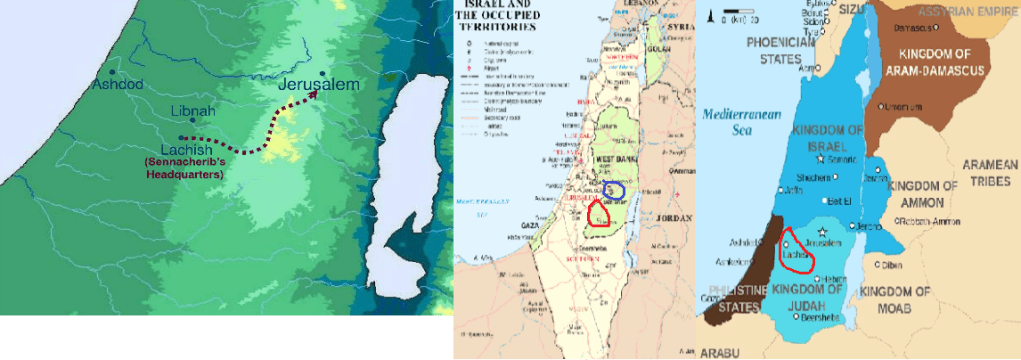
To sort things, a Rabshakeh was a high-ranking Assyrian official that was given authority over a great army. He was sent by Sennacherib as a show of overwhelming force and a negotiating tactic to deliver the message to king Hezekiah. The Rabshakeh and great army were sent from Lachish which was a fortified city of Judah that Sennacherib conquered. That would be similar to a hostile army setting up a base in New Jersey then sending an ambassador, with a great army to send a message to Washington D.C., the capital of the United States of America. Lachish was located on the main route from Jerusalem [capital of Judah] to Egypt. Sennacherib occupied Lachish because Hezekiah was planning to send ambassadors back and forth from Egypt to form a military alliance to defend against Sennacherib, the king of Assyria. That would be like hostile forces existing within America and cutting off the main routes of military alliances with the U.S.A.
On the image below, the picture to the far left clearly shows where Lachish and Libnah are in comparison to Jerusalem. Jerusalem was the capital of the kingdom of Judah. On the picture in the middle, the red circle shows where Lachish and Libnah are within the territory of the West Bank of the State of Israel today. The blue circle is where Jerusalem is, now divided between West and East Jerusalem, West being within the State of Isarel and the East being part of the West Bank. The picture to the far right shows the kingdom of Israel to the north and the kingdom of Judah to the south, as it was in the times of Isaiah. Libnah and Lachish were to the southwest of Jerusalem the capital of the kingdom of Judah.
A lot can be said about the route from Jerusalem to Egypt being cut off by the Assyrians. Today, the pathway to the independence of Israel is being whittled away by the West Bank. Also, the occupation of “Lachish” mirrors the difficult relationship between Israel and the United States of America, which is based on military and political power. The sentiments of today’s global culture, the entire international community, are working to cut off Israel’s pathway to the United States.
The Rabshakeh stood by the aqueduct at the upper pool, which was on the highway to the Fuller’s Field. The Fuller’s Field is also known as the “Launderer’s Field”. The aqueduct is symbolic for the flow of the Water of Life [Jesus gives the Water of Life], and the “Fuller’s Field” is symbolic for having our spirit washed by faith in Christ Jesus. The dark forces of the enemies of Hezekiah [Hezekiah was faithful to the word of God] sent their message to Hezekiah from the upper pool on the highway to the Fuller’s Field. Those places provided water and laundering to Jerusalem, the capital of Judah. Today, that is like a hostile government threatening the water supply of a main water conduit and threatening the ability of the citizens to remain uncorrupted. In other words, threatening to corrupt the spiritual cleanliness of a nation by threatening those who live by the decency of spiritual Holiness. Those threats include harming vital infrastructure unless demands are met.
Today, we are living in a world where the government of the beast has positioned itself where the Water of Life is meant to flow, as quoted, “Do you not know that you are the temple of God and that the Spirit of God dwells in you?” 1 Corinthians 3:16 The beast does not want us to be washed in the Holy Spirit, but wants us to live in spiritual corruption where people are receptive to the beast that gives them what to speak, do, think, and feel. By doing that, the beast is able to sit in the temple of God, our God, as if is God, and is the one, “…who opposes and exalts himself above all that is called God or that is worshiped, so that he sits as God in the temple of God, showing himself that he is God.” 2 Thessalonians 2:4 Click for a post on that.
The army that is stationed at the “upper pool” on the highway to the “Launderer’s Field” is the culture of the beast, which is global. The message from the governing authority of the beast to national cultures around the world, is that the global government has a powerful army located within their cities and states. That army is living in spiritual darkness, and unless their demand is met, nations will be overtaken by lawlessness, destruction, death, and darkness. The demand is for cities, states, and nations to conform to the agenda of the United Nations, which is publicized through the “Sustainable Development Goals”. The United Nations was established in 1945, immediately after World War 2, and brought the government of the beast with it, as described in Daniel 8:1-14 and also in Revelations 17. The beast is described in Revelations 13.
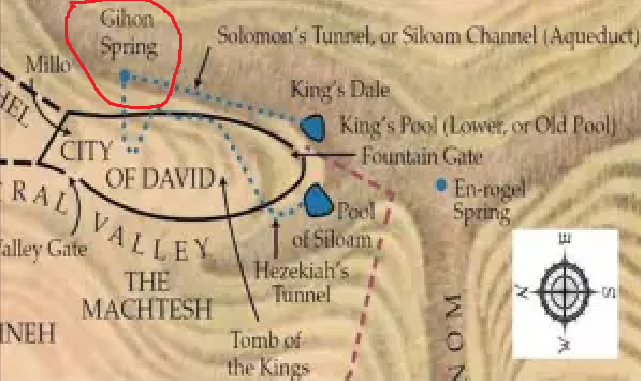
On the map below, the area circled in red [Gihon Spring] is where the “upper pool” was located, which was at the end of the aqueduct, on the road to the Fuller’s Field. The Fuller’s Field is also known as the Launderers Field, which was the water source for washing clothes. The “City of David” is Jerusalem.
Hezekiah sends ambassadors to receive the message of Sennacherib.
“And Eliakim the son of Hilkiah, who was over the household, Shebna the scribe, and Joah the son of Asaph, the recorder, came out to him. Then the Rabshakeh said to them, “Say now to Hezekiah, ‘Thus says the great king, the king of Assyria: “What confidence is this in which you trust?” Isaiah 36:3-4
From that verse, we see how representatives of Hezekiah, the king who was loyal to God, comes to receive the message of the king that used worldly power and force against the king loyal to the word of God. As followers of Jesus Christ, every day we are receiving the message from those who live for the beast that gives them what to do, say, think, and feel. That message is expressed in their opposition to our belief in God the Creator, in their vehement rejection to the Gospel of Christ, and their war against the presence of the Holy Spirit.
Eliakim was like the chief-of-staff within the government administration. Hilkiah, Eliakim’s father, was the High Priest who discovered the Book of Law, which was the Law of Moses, referring to the book of Deuteronomy. The Book of Law contained the Ten Commandments and the laws of animal sacrifices to atone for sin. “Then Hilkiah the high priest said to Shaphan the scribe, “I have found the Book of the Law in the house of the Lord.” And Hilkiah gave the book to Shaphan, and he read it. 2 Kings 22:8 The Book of Law was lost, buried in the temple of Jerusalem somewhere, due to years of idolatry, trying to blend in with the surrounding cultures, and political corruption. That describes where the Gospel of Jesus Christ is within the churches of today.
When Hilkiah found the Book of Law, it was a time of revival in living once again by the word of God. King Josiah [of Judah] spread the word of God throughout the land, as quoted, “Now the king sent them to gather all the elders of Judah and Jerusalem to him. The king went up to the house of the Lord with all the men of Judah, and with him all the inhabitants of Jerusalem—the priests and the prophets and all the people, both small and great. And he read in their hearing all the words of the Book of the Covenant which had been found in the house of the Lord. Then the king stood by a pillar and made a covenant before the Lord, to follow the Lord and to keep His commandments and His testimonies and His statutes, with all his heart and all his soul, to perform the words of this covenant that were written in this book. And all the people took a stand for the covenant.” 2 Kings 23:1-3
Shebna was a scribe and as a scribe was responsible for writing, copying, and preserving the law. By doing that, he would have had extensive knowledge of the Law of Moses, like we who have extensive knowledge of the Gospel of Jesus Christ by our born-again experience. Our born-again experience is the Gospel of Christ written on our heart. Joah was a recorder, and as a recorder would be responsible for writing notes to document the event and decisions that happened during the meeting with the representatives of Sennacherib. As followers of Jesus Christ, we record the events and happenings within today’s world relating to where God, Jesus, and Holy Spirit are within the culture of the beast. “For the testimony of Jesus is the spirit of prophecy.” Revelations 19:10 If we want to know where the world is within prophecy we only have to know where Jesus is within the world.
As followers of Jesus Christ, we are sent out as sheep amidst the wolves, and we hear the dark and atheistic message coming from the culture of the beast. The Gospel of Jesus Christ is written on our heart through the born-again experience, and day-by-day we are recording the happenings of today’s events. We realize that today’s culture is synchronized as one in what the beast gives them to say, do, think, and feel. They oppose the light of Jesus Christ as they embrace the power of darkness that speaks and lives through them. By what they are given to say and do, they are conformed to the mark, name, number of the beast.
Those who live and govern for the beast asks we who live for Jesus Christ, “What confidence is this in which you trust?” Isaiah 36:3-4 That question is the subject of the next verses.
Sennacherib boasts of the futility of a military alliance and mocks faith in the word of God.
“I say you speak of having plans and power for war; but they are mere words. Now in whom do you trust, that you rebel against me? Look! You are trusting in the staff of this broken reed, Egypt, on which if a man leans, it will go into his hand and pierce it. So is Pharaoh king of Egypt to all who trust in him.” Isaiah 36:5-6
There was a time when Hezekiah turned from trusting the Lord and put his trust in Egypt, as quoted, “Woe to the rebellious children,” says the Lord, “Who take counsel, but not of Me, and who devise plans, but not of My Spirit, that they may add sin to sin; Who walk to go down to Egypt, and have not asked My advice, to strengthen themselves in the strength of Pharaoh, and to trust in the shadow of Egypt!” Isaiah 30:1-3 But as revealed in the post on Isaiah 37:1-7, Hezekiah returns to the Lord to seek counsel from Isaiah on how to respond to the threat from Sennacherib, the king of Assyria.
The Assyrian likened the plan to trust in Egypt as being empty words because Egypt would not be able to help Hezekiah, the king of Judah. Sennacherib knew that trusting in Egypt would be like leaning on a bent cattail plant for support. The Spirit of the Lord says that exact same thing in this verse from Ezekiel, “Then all the inhabitants of Egypt will know that I am the LORD, because they have been a staff of reed to the house of Israel” Ezekiel 29:6.
The Lord explicitly says to we who put our faith in Jesus Christ that peace, safety, and security does not come by reliance on the political and military power of this world. The peace we have in our Lord Jesus is not the type of peace that this world brings but is an internal peace through the presence of the Holy Spirit. We walk in that light and are not walking by those who are blinded by the ways of this world. “‘Not by might nor by power, but by My Spirit,’ says the Lord of hosts...Peace I leave with you, My peace I give to you; not as the world gives do I give to you. Let not your heart be troubled, neither let it be afraid.” Zachariah 4:6, John 14:27
The nations of this world are being dominated by the government of the beast as governors of nations everywhere are being subjected to live and govern by the words, thoughts, behaviors, and feelings that the beast gives them to govern by. They are being subjected to the power of darkness that opposes belief in God, Christ Jesus who forgives unbelief, and the Holy Spirit who convicts of sin. The attitude of those who govern and live for the beast is, “Now in whom do you trust, that you rebel against me?” That is the same attitude that is spoken about in this verse, speaking of the culture of the beast, “Who is like the beast? Who is able to make war with him?” Revelations 13:4
“But if you say to me, ‘We trust in the Lord our God,’ is it not He whose high places and whose altars Hezekiah has taken away, and said to Judah and Jerusalem, ‘You will worship before this altar’?” Isaiah 36:1-7
When Hezekiah returned the worship of God to the kingdom of Judah, he declared to all the people, “You will worship before this altar’?” Hezekiah was returning obedience to the word of God, who says, “You will fear the Lord your God and serve Him, and will take oaths in His name. You will not go after other gods, the gods of the peoples who are all around you…” Deuteronomy 6:13-14
The people of the kingdom of Judah had adopted the gods of other nations as their god and that is what they worshipped on high hills where they built altars to those false gods. Sennacherib, through the Rabshakeh, was mocking Hezekiah for taking away the gods that all the people were worshipping as God. In essence, Sennacherib was mockingly saying, “If you say, ‘We trust in the Lord our God’ is that the same God whose altars you tore down in the high places?”
Today, those of the culture of the beast dominate within the manmade churches. They worship the beast that has power over physiology to give them what to say, do, think, and feel and have abandoned the Gospel of Jesus Christ. As followers of Jesus Christ, when we say, “We trust in the Lord our God,” today’s culture mockingly responds in their attitude, “Is that same God that is being worshipped within the churches today?”
Today, the beast has set itself up within the temple of God, our body, by giving people what to think, feel, do, and say. That is the beast “…who opposes and exalts himself above all that is called God or that is worshiped, so that he sits as God in the temple of God, showing himself that he is God.” 2 Thessalonians 2:4 Click for a post on that. Those who serve the beast say in their attitude and behavior, “Who is like the beast? Who is able to make war with him?” Revelations 13:4
King Hezekiah was the son of king Ahaz and ruled as the king of Judah after his father. It was Ahaz who did away with the worship of the Living God and paid money to the king of Assyria at that time for protection. “So Ahaz gathered the articles of the house of God, cut in pieces the articles of the house of God, shut up the doors of the house of the Lord, and made for himself altars in every corner of Jerusalem. And in every single city of Judah he made high places to burn incense to other gods, and provoked to anger the Lord God of his fathers.” 1 Chronicles 28:24 “So Ahaz sent messengers to Tiglath-Pileser king of Assyria, saying, “I am your servant and your son. Come up and save me from the hand of the king of Syria and from the hand of the king of Israel, who rise up against me.” And Ahaz took the silver and gold that was found in the house of the Lord, and in the treasuries of the king’s house, and sent it as a present to the king of Assyria.” 2 Kings 16:7-8
King Hezekiah was the son of king Ahaz, and Ahaz was the son of king Jotham, Jotham, Ahaz, and Hezekiah are spoken about in the post on Micah 1:1.
The events of this passage of Isaiah 36:1-7 are recorded in 2 Kings 18:17-37. 1 Kings and 2 Kings were written after the book of Isaiah.
“….to you who do not hold to her teaching and have not learned Satan’s so-called deep secrets,“
‘I will not impose any other burden on you, except to hold on to what you have until I come.’”
“I am coming soon. Hold on to what you have, so that no one will take your crown.”
Revelation 2:24-25, 3:11
Discover more from Spiritual Society in Jesus Christ
Subscribe to get the latest posts sent to your email.


3 thoughts on “Sennacherib overtakes the strongholds in Judah and mocks dependence on worldly powers and the Living God.”